IPv4 Addresses
two examples of ip addresses: 10.2.5.58 // 205.123.1.8
addresses at every layer
In a network, different layers use different kinds of addresses:
- At the lowest physical level, an address is nothing more than
a connector on a network card or a switch port. - At the Ethernet/MAC layer, we have MAC-addresses.
- At the IP layer, we have IP-addresses.
- At the TCP/UDP layer, there are port numbers.
In this module, we focus on IP addresses in the network or internet layer,
specifically the addresses of IP version 4.
what Is an IP Address?
An IP address is a logical network address belonging to a specific host;
a host is any device connected to the network.
An IP address serves two purposes:
- identification of the host
- location of the host, enabling routers to deliver packets to it
what Does It Look Like?
An IPv4 address is 32 bits long.
This address is usually written in dotted-decimal notation:
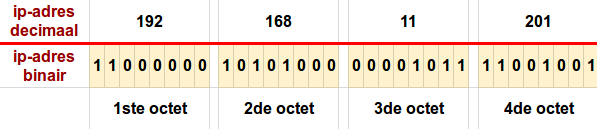
as in this example: 192.168.11.201/24
the /24 is the so called NETMASK
The 32 bits are divided into four octets of 8 bits each.
Each octet is then converted to decimal and separated by three dots,
as above: 192.168.11.201 = 11000000.10101000.00001011.11001001