The frame
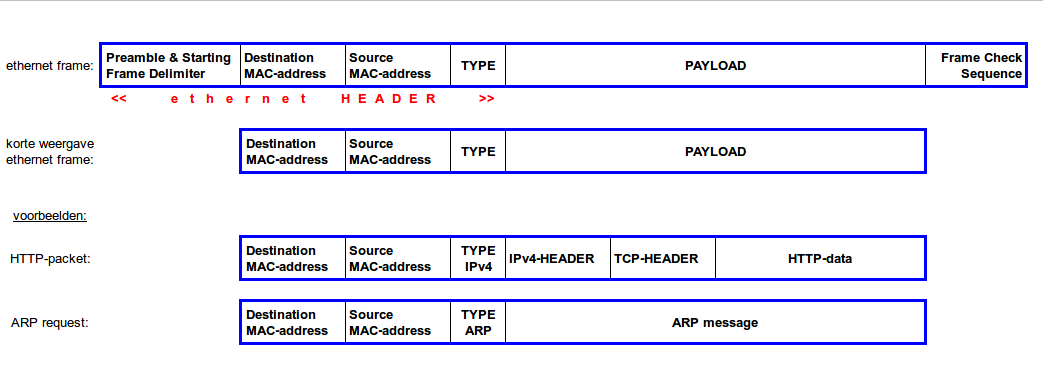
An Ethernet frame is a delimited unit of forwarded data containing several fields for, among other things, addressing and error detection.
preamble
The preamble does not take part in the communication itself. It is a field used to synchronize the receiver.
In Ethernet, the preamble looks like this:
10101010 10101010 10101010 10101010 10101010 10101010 10101010 10101011
In Ethernet 802.3, the preamble consists of the first 7 octets shown above; the last octet is then called the starting frame delimiter. An octet is a group of 8 bits. In the example above, the 8 octets are separated by spaces.
As soon as the receiver gets a double 1, it knows that the real data from the MAC layer is beginning.
destination MAC address
MAC address of the destination.
A MAC-address, also called a physical address, is embedded in the hardware. It consists of 6 octets. The first 3 octets are a unique manufacturer code, and the last 3 octets are a serial number.
source MAC address
MAC address of the sender.
type field
A pointer to the higher layer above MAC, often IPv4 (0800), IPv6 (86DD) or ARP (0806). There are others.
payload
Also often called DATA.
The PAYLOAD contains the headers of the higher layers in the protocol stack. Finally, the PAYLOAD also contains the message.
frame check sequence
The frame check sequence is a checksum, often called CRC (cyclic redundancy check).
The checksum of the frame is attached as the last 32‑bit field. The receiver recalculates it. If a difference occurs, the receiver assumes an error happened during the transfer of the frame. The frame is then DROPPED.