The Practical Model for NETwork layers – Part 1
The practical model we use in this course is a combination
of the TCP/IP protocol stack on top of Ethernet.
Model
The practical model is, first of all, a model.
We represent the protocols that work together as a set of vertical processes that pass information to one another. We speak of layers.
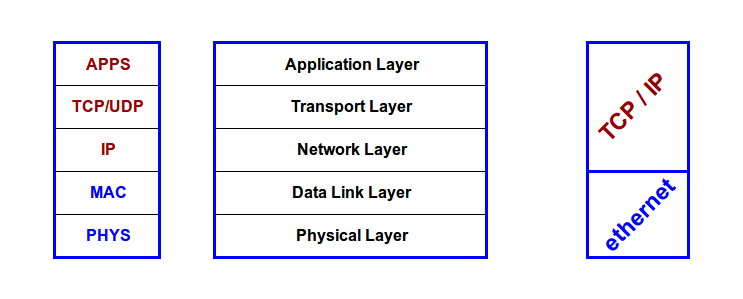
- Within a single machine, a given layer only cooperates with the layers directly above or directly below it.
- Between two different machines, a layer only cooperates with the same layer on the other machine. This is called horizontal communication.
A protocol is a set of agreements, a framework, within which communication with another machine is established using keywords. Protocols operate horizontally.
An application usually consists of a service on one machine and a client on another machine, both using the same protocol.
A protocol stack is a vertical stack of protocols. Within one machine, they ensure together that each application, layer by layer (top-down), enters a transmission medium (cable or wireless) in the correct way, with the proper addresses. After this, the packet flows through the network to the correct destination, then climbs back up the protocol stack (bottom-up) at the destination to reach the right application.
TCP/IP and Ethernet
- TCP/IP is the protocol stack that underpins the Internet.
- Ethernet is the technology most commonly used to connect desktops, laptops, and servers via cable in a local area network (LAN).
The practical model of this course is the one most students themselves use when working on a wired connection with LAN or the Internet. It is also the model used by nearly all companies in the workplace and within data centers to interconnect servers.
Other Models
- The DOD model (Department of Defense) is TCP/IP without a description of the lower layers.
- The OSI model (Open Systems Interconnection) is mainly a conceptual model with 7 layers, from which application developers draw inspiration.
Next Steps
In what follows, we will discuss the top-down five layers and their areas of application within the practical model.
The Practical Model for NETwork layers – Part 2
In this second part we briefly look at the five layers of the practical model from top to bottom (top-down).
The two lowest layers of the practical model together form Ethernet.
The three upper layers together form TCP/IP. TCP/IP is a protocol stack, a set of protocols that all work together.
The layers are numbered from bottom to top.
Because the historical protocol stacks SNA, Decnet, and OSI had 7 layers, the top application layer still carries number 7. The OSI layers 6 (presentation layer) and 5 (session layer) are not implemented as separate protocols in TCP/IP, though their functions are still identifiable.
Application Layer
This is the most important layer. It is the reason we build networks. We need applications, and to make them function via a network, we need an application protocol.
In the practical model, it is not the application itself that matters, but the protocol (client-server / peer-to-peer) that enables communication—for example, between a web server (Apache) and a web browser (Firefox). In this specific case, the protocol is HTTP.
In the application layer, we speak of messages.
There are hundreds (even thousands) of application protocols, such as:
- HTTP for web browsing
- SMTP for email transfer
- POP3 or IMAP4 as mailbox protocols
- FTP and SFTP for file transfer
- SSH for secure remote terminal work
- Rdesktop for remote GUI work
- SAMBA and NFS for file and printer sharing
- DNS to work with domain names
- DHCP to distribute IP addresses
Transport Layer
There are only two protocols in this layer: TCP (Transmission Control Protocol) and UDP (User Datagram Protocol).
The differences will be explained later.
- A TCP packet in the transport layer is called a segment when emphasizing this layer.
- UDP is a connectionless protocol; its packets are called datagrams.
The transport layer is responsible for:
- Reliable end-to-end transport of data (via acknowledgements – ACK) (connection-oriented)
- Error control and correction
- Segmenting messages from the higher layer (splitting into pieces)
- Sequencing (numbering) the different segments (the split pieces)
- Multiplexing: assigning a unique port number to different processes that simultaneously use the transport layer
- Flow control and timing
- Session management: establishing the connection (SET UP), maintaining it (KEEP ALIVE), and terminating it (TEAR DOWN)
Network Layer
IP (Internet Protocol) is the only protocol in the network layer. There are two versions: IPv4 and IPv6.
IP packets are datagrams (connectionless).
The two main functions of IP are:
- Network addressing
- Finding the route (path) hop-by-hop between sender and final destination of a packet
Data Link Layer
In the practical model, this is the MAC layer of Ethernet.
Functions implemented by the Ethernet MAC layer:
- Extracts a frame with a beginning and end from the bitstream of the physical layer
- Provides locally unique addresses
- Performs error checking via a checksum at the end of the frame
- Manages access to the network: when and how to place data on the medium
(using CSMA/CD – Carrier Sense Multiple Access with Collision Detection) - Identifies the higher layer via a type field
A MAC packet is called a frame.
Physical Layer
The physical layer deals with the electrical signal or electromagnetic wave (wireless) used to transmit data between two or more points.
Here we find:
- Standard definitions of the signal
- Encoding of bits (0 or 1) into signals (voltage)
- Standards for connectors and cables
In the physical layer, we speak of the bitstream.
The TCP/IP model does not have a separate session layer; its functionality is combined with the transport and application layers. In the theoretical OSI model, the session layer (Layer 5) manages the connection between two devices, handling dialogue control, session setup, and termination. In the practical TCP/IP model, protocols like TCP manage connections, while applications at the application layer are responsible for managing the overall session through protocols like HTTP.
The TCP/IP model does not have a separate presentation layer; its functions are combined within the
Application layer. In the theoretical OSI model, the Presentation layer is responsible for tasks like data encryption, compression, and translation. In contrast, the TCP/IP model, which is more practical for real-world internet communication, handles these functions at the Application layer along with session management and user interface aspects.